
Dog feeding guide
How Much Should I Feed My Dog? Daily Calories by Weight, Age and Activity
A four-step method for working out how much your adult dog needs: find the right body weight, estimate daily calories, convert them into grams of your dog’s food, then adjust using body condition.
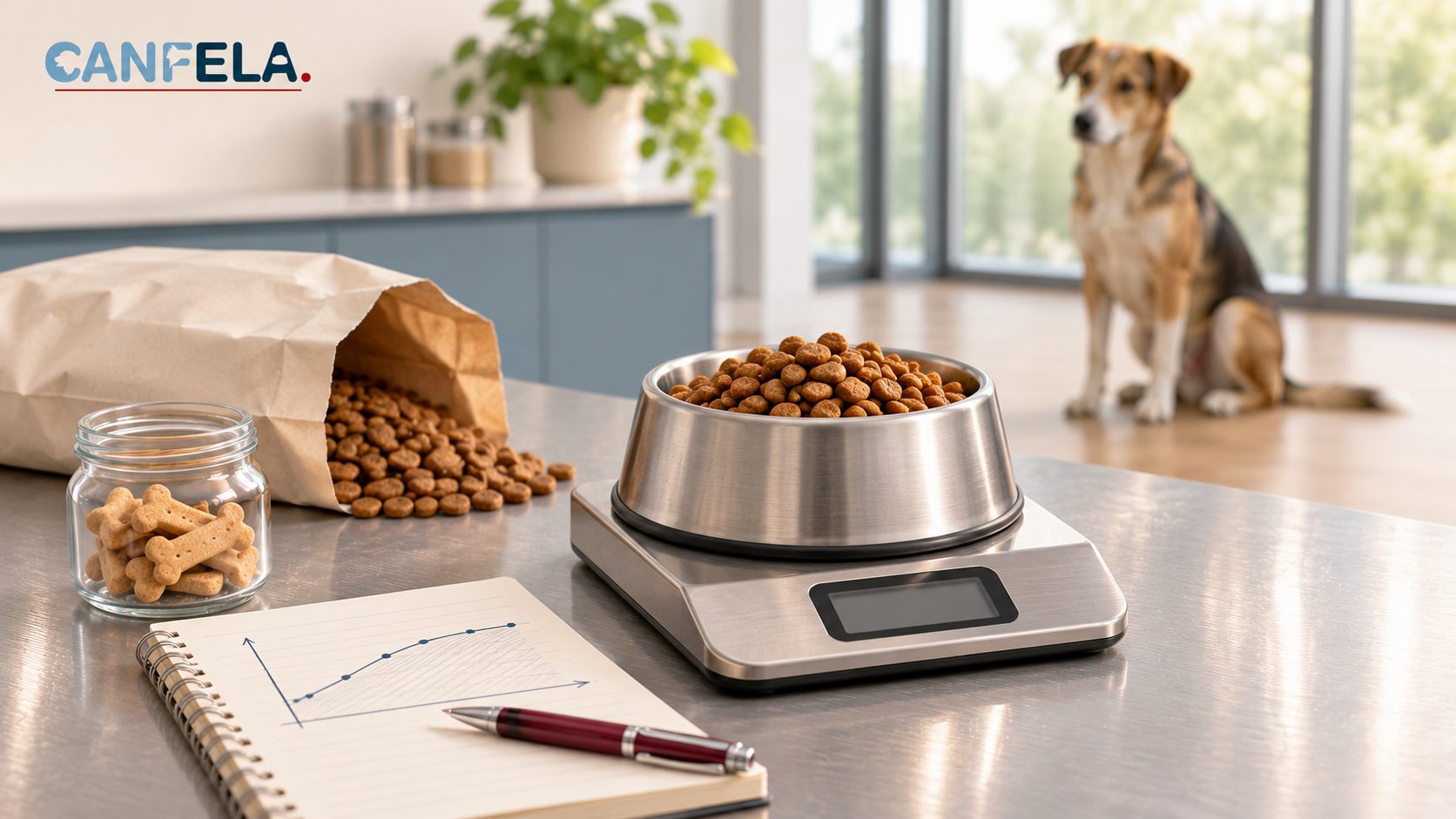 With free calculator
On this page
“How much should I feed my dog?” sounds like it should have one simple answer printed on the bag. In practice, two healthy dogs of the same weight can need very different amounts of food, and the right amount for your dog is something you find, not something you read.
This guide gives you a scientific starting point based on the European pet food industry’s nutritional guidelines (FEDIAF 2025), shows you how to turn it into grams of your dog’s own food, and explains how to adjust it over the following weeks. If you would rather skip the arithmetic, our free dog and cat calorie calculator uses the same equations.
Quick answer
A typical healthy adult dog (3 to 7 years old) needs roughly 110 kcal × body weight in kg0.75 per day; about 1,040 kcal for a 20 kg dog. Use about 130 for young adults (1 to 2 years), about 95 for seniors or dogs walked less than an hour a day, and 90 or less for dogs that gain weight easily. Divide the result by the calorie content on the food label to get grams per day, weigh the food with a kitchen scale, and re-check your dog’s weight and body condition every 2 to 4 weeks, adjusting the amount in small steps.
Evidencestated in a guideline or study Guidanceour professional interpretation Uncertainvaries between dogs
Before you start
Why the feeding guide on the bag is only a starting point
EvidenceFEDIAF states that energy requirements vary considerably between individual dogs, even between dogs kept under the same conditions, because of differences in age, breed, size, body condition, coat, temperament, health and activity. It concludes that no single formula can calculate the energy needs of every dog and that published recommendations should be treated as starting points (FEDIAF, 2025).
EvidenceThe same guidelines note that maintenance recommendations may overestimate real needs by 10 to 60%, partly because they assume a reasonable amount of exercise, while survey data cited by FEDIAF found that about 22% of owners exercised their dogs for less than three hours a week (FEDIAF, 2025). AAFCO makes the same point to consumers: feeding directions are guidelines that may need to be changed for an individual pet (AAFCO).
GuidanceSo the goal is not to find the “correct” number on a chart. It is to start close, then let your dog’s weight and body condition tell you whether to feed a little more or a little less.
Step 1Find the right body weight to feed for
EvidenceEnergy requirements should be based on your dog’s optimal body weight, not simply the weight on the scale today. FEDIAF recommends combining body weight with a 9-point body condition score (BCS), a hands-on assessment of body fat that has been validated for dogs (FEDIAF, 2025; WSAVA). For dogs, the ideal score is 4 to 5 out of 9.
| Score | What you see and feel | Approx. weight vs ideal |
|---|---|---|
| 1–3 (too thin) | Ribs, spine and hip bones easy to see; little or no fat cover; pronounced waist and tuck. | 20–40% or more below |
| 4–5 (ideal) | Ribs not visible but easily felt under a thin layer of fat; clear waist from above; belly tucked up from the side. | Ideal |
| 6 (slightly overweight) | Ribs felt under moderate fat; waist and tuck less obvious. | About 10–15% above |
| 7 (overweight) | Ribs hard to feel under thick fat; little waist; back slightly broadened. | About 20–30% above |
| 8–9 (obese) | Ribs very hard or impossible to feel; no waist; fat over the lower back, neck and limbs; belly may hang. | 30–45% or more above |
Adapted from the FEDIAF 2025 body condition guide (Annex 7.1). WSAVA publishes a free illustrated chart for owners (WSAVA).
GuidanceIf your dog scores 4 or 5, feed for its current weight. If it scores 6 or more, do not use today’s weight: use an estimate of its ideal weight, and ask your veterinarian to confirm the target before starting any weight-loss plan. Because the formula uses weight to the power 0.75, feeding for the heavier current weight would keep an overweight dog overweight.
Step 2Estimate how many calories your dog needs a day
EvidenceA dog’s energy needs do not rise in a straight line with body weight. FEDIAF and the U.S. National Research Council express them per kilogram of metabolic body weight, which is body weight in kg raised to the power 0.75 (FEDIAF, 2025). That is why a 40 kg dog needs far less than twice as much food as a 20 kg dog.
The calculation is: daily kcal = factor × (body weight in kg)0.75. FEDIAF gives these factors for healthy adult dogs:
| Dog | Factor | Range |
|---|---|---|
| Young adult, 1–2 years | 130 | 125–140 |
| Adult, 3–7 years | 110 | 95–130 |
| Senior, over 7 years | 95 | 80–120 |
| Low activity (under 1 h/day, e.g. lead walks) | 95 | – |
| Moderate activity (1–3 h/day), low impact | 110 | – |
| Moderate activity (1–3 h/day), high impact | 125 | – |
| High activity (3–6 h/day, working dogs) | 150–175 | – |
| Obese-prone adults | 90 or less | – |
Source: FEDIAF 2025, Tables VII-6 and VII-7. ME = metabolisable energy, the energy value declared on pet food labels.
Daily calories by body weight
Here is what those factors mean in practice, rounded to the nearest 10 kcal:
| Ideal weight | Obese-prone (90) | Senior or low activity (95) | Adult, 3–7 years (110) | Young adult (130) |
|---|---|---|---|---|
| 5 kg | 300 | 320 | 370 | 430 |
| 10 kg | 510 | 530 | 620 | 730 |
| 15 kg | 690 | 720 | 840 | 990 |
| 20 kg | 850 | 900 | 1,040 | 1,230 |
| 25 kg | 1,010 | 1,060 | 1,230 | 1,450 |
| 30 kg | 1,150 | 1,220 | 1,410 | 1,670 |
| 40 kg | 1,430 | 1,510 | 1,750 | 2,070 |
| 50 kg | 1,690 | 1,790 | 2,070 | 2,440 |
EvidenceFEDIAF notes that, to avoid overfeeding and the risk of obesity, it may be better to start from a lower calculated value and add food as needed (FEDIAF, 2025).
GuidanceWhen you are unsure which column fits, choose the lower one. For most pet dogs that means starting at 95 to 110, not 130.
Step 3Convert calories into grams of your dog’s food
EvidenceIn the United States, AAFCO’s model regulations require the calorie statement on a dog food label to appear under the heading “Calorie Content” and to be expressed as kilocalories per kilogram of food as fed, usually with a value per cup or can as well (AAFCO). Many European labels also declare energy. If yours does not, ask the manufacturer; reputable brands can give you the value.
Once you have it, the arithmetic is simple:
grams per day = daily kcal ÷ (kcal per kg ÷ 1,000)
Worked example
A 20 kg, four-year-old dog with an ideal body condition and about an hour of walking a day: 110 × 200.75 ≈ 1,040 kcal per day. Its dry food provides 3,600 kcal per kg, which is 3.6 kcal per gram. 1,040 ÷ 3.6 ≈ 290 g of food per day, split into two meals of about 145 g. If the dog also gets treats, reduce the food so that the total stays the same (see below).
3,600 kcal/kg is an example only. Dry foods, wet foods and fresh foods differ widely in energy density, so always use the value for your dog’s food. Comparing foods with very different moisture content is easier on a dry matter basis.
Weigh the food instead of scooping it
EvidenceMeasuring cups are surprisingly inaccurate. A study that pooled twelve trials of people measuring dry kibble with a cup found portions ranging from 18% below to 80% above the intended amount, with larger errors for small portions; the authors suggested that such errors could contribute to gradual weight gain (German et al., 2011).
GuidanceA simple kitchen scale removes most of that error. Weigh the daily amount in the morning and take each meal from it, so that extra handfuls are easy to notice.
Count treats as part of the day
EvidenceThe WSAVA nutritional assessment guidelines list snacks, treats and table food above 10% of total calories as a risk factor that calls for a closer look at the diet (WSAVA Nutritional Assessment Guidelines Task Force, 2011).
GuidanceKeep treats and extras below 10% of the day’s calories and reduce the main food by the same amount. For the 20 kg dog above, that means up to about 100 kcal of treats and about 260 g of food instead of 290 g. Treats are rarely complete and balanced, so letting them grow beyond that can unbalance the whole diet, not just the calories.
Step 4Weigh, score and adjust
EvidenceFEDIAF stresses that its tables give averages and that owners have to adapt the amount when their animal tends to gain or lose weight (FEDIAF, 2025).
GuidanceA practical routine for a healthy adult dog:
- Weigh your dog every 2 to 4 weeks on the same scale, at the same time of day, and check its body condition score.
- If weight and BCS are stable at 4–5/9, you have found the right amount. Keep it, and re-check monthly.
- If your dog is gaining weight, reduce the daily amount by about 10% and re-check in 2 to 4 weeks.
- If your dog is losing weight it does not need to lose, increase by about 10% and re-check.
- Change one thing at a time. If you switch food, treats or exercise at the same time, you will not know which change worked.
UncertainSmall changes in weight from day to day are normal. Look at the trend over several weeks rather than a single reading.
Why it matters
Feeding the right amount can add years to a dog’s life
EvidenceOverweight dogs are common. FEDIAF cites U.S. data showing that about one third of dogs and cats over one year of age seen in veterinary practices were overweight or obese, rising to almost 50% between 6 and 11 years of age, with similar figures in Europe (FEDIAF, 2025).
EvidenceIn a lifelong study of 48 Labrador Retrievers, dogs fed 25% less than their paired littermates stayed leaner, had a significantly longer median life span, and generally showed clinical signs of chronic disease later (Kealy et al., 2002). Based on this study, FEDIAF recommends feeding dogs to maintain a body condition score between 4 and 5 out of 9 (FEDIAF, 2025).
Individual differences
What changes how much a dog needs
- EvidenceAge. Dogs over seven may need 10 to 15% less energy than at three to seven years, mainly because they are less active; older dogs that still run and play may need more than the table suggests (FEDIAF, 2025).
- EvidenceActivity. Activity is one of the biggest drivers of energy needs, from about 95 kcal per kg0.75 for dogs walked on the lead to 150–175 for working dogs (FEDIAF, 2025).
- EvidenceBreed. Some breeds sit outside the usual range: FEDIAF lists about 200 kcal per kg0.75 for Great Danes and about 105 (80–132) for Newfoundlands (FEDIAF, 2025).
- EvidenceClimate and housing. Dogs kept outdoors in winter may need 10 to 90% more calories than in summer (FEDIAF, 2025).
- GuidanceNeutering and lifestyle. Many neutered, indoor or less active dogs belong in the “obese-prone” group and do best at the lower end of the range. Watch the body condition score closely in the months after neutering.
Special cases
Puppies, pregnant dogs and when to involve your veterinarian
EvidenceThe adult factors above do not apply to puppies, or to pregnant or nursing dogs. FEDIAF uses a separate growth equation for puppies from 8 weeks to 1 year, based on current weight and expected adult weight, and warns that puppies should never be fed free-choice: overfeeding accelerates growth, which can lead to skeletal problems, especially in large and giant breeds (FEDIAF, 2025). Our calorie calculator includes this puppy equation.
GuidanceTalk to your veterinarian before changing how much you feed if your dog:
- is losing or gaining weight without an obvious reason, or has changed its appetite or thirst;
- has a medical condition, takes regular medication or is on a veterinary diet;
- is overweight and needs a weight-loss plan (weight loss should be planned and monitored, not improvised);
- is pregnant, nursing, very old or very young.
Nutrition advice is not a substitute for a veterinary examination. For dogs with medical conditions, CANFELA’s Clinical Nutrition Program works alongside your veterinarian.
Practical tool
Dog feeding checklist
Six checks to get your dog’s portion right. Your progress is saved in this browser.
For healthy adult dogs. It does not replace advice from your veterinarian.
Frequently asked questions
Dog feeding FAQ
How many calories does a 20 kg dog need per day?
Using the FEDIAF factor for an average adult dog of 3 to 7 years (110 kcal per kg0.75), a healthy 20 kg dog needs about 1,040 kcal per day. A senior or less active dog of the same weight may need about 900 kcal, and a very active young adult about 1,230 kcal. These are starting points; adjust them to your dog’s body condition.
How many grams of dry food should I feed my dog?
Divide your dog’s daily calories by the energy content of the food in kcal per gram. For example, 1,040 kcal per day of a dry food with 3,600 kcal per kg (3.6 kcal per gram) is about 290 g per day. Because foods differ widely in energy content, the same dog may need very different amounts of two different foods.
Are the feeding guides on dog food bags accurate?
They are reasonable averages, but they cannot know your dog’s age, activity, coat, neuter status or metabolism. FEDIAF notes that maintenance recommendations may overestimate the needs of many pet dogs by 10 to 60%, and AAFCO describes feeding directions as guidelines that may need to be adjusted. Use them as a starting point and adjust based on weight and body condition.
How do I know if my dog is overweight?
Use a body condition score. At an ideal score (4 to 5 out of 9), you can easily feel the ribs under a thin layer of fat, you can see a waist from above, and the belly is tucked up when seen from the side. If the ribs are hard to feel and the waist has disappeared, your dog is likely overweight. Your veterinarian can confirm the score and the ideal weight.
Should I feed my dog once or twice a day?
Most healthy adult dogs do well on two meals a day, which also makes it easier to divide a weighed daily amount. Puppies need more frequent meals. Some dogs with medical conditions need a specific schedule, which your veterinarian will advise. The total daily amount matters more than the number of meals.
Do treats count towards my dog’s daily calories?
Yes. Treats, chews and table scraps all add calories. Keep them below about 10% of daily calories, in line with the WSAVA nutritional assessment guidelines, and reduce the main meal so that the daily total stays the same.
Personal support
Want a feeding plan made for your dog?
A calculator gives an average. CANFELA can look at your dog’s age, breed, body condition, activity and current food, and give you a precise plan.
CANFELA provides nutrition consulting, not veterinary diagnosis or treatment. Dogs with medical conditions should be under the care of a veterinarian.
Primary sources
References and further reading
- FEDIAF. (2025). Nutritional Guidelines for Complete and Complementary Pet Food for Cats and Dogs. Annex 7.1 (Body condition score) and Annex 7.2 (Energy). Publication September 2025.
- Association of American Feed Control Officials. Reading Labels (calorie content and feeding directions).
- World Small Animal Veterinary Association, Global Nutrition Committee. Global Nutrition Guidelines and Toolkit (including body condition score charts for dogs).
- WSAVA Nutritional Assessment Guidelines Task Force. (2011). WSAVA nutritional assessment guidelines. Journal of Feline Medicine and Surgery, 13(7), 516–525. Also published in Journal of Small Animal Practice, 52, 385–396.
- German AJ, Holden SL, Mason SL, et al. (2011). Imprecision when using measuring cups to weigh out extruded dry kibbled food. Journal of Animal Physiology and Animal Nutrition, 95(3), 368–373.
- Kealy RD, Lawler DF, Ballam JM, et al. (2002). Effects of diet restriction on life span and age-related changes in dogs. Journal of the American Veterinary Medical Association, 220(9), 1315–1320.
Ready for a precise plan?
Feed your dog for its body, not for the bag.
Tell CANFELA about your dog’s age, weight, activity and current food.
This article provides general nutrition information for healthy adult dogs. It is not veterinary advice and does not replace an examination by a veterinarian. Dogs with medical conditions, puppies and pregnant or nursing dogs need individual advice. Back to top ↑